Quick answer
When the power returns after an outage, check your water company's latest update before putting away your emergency supplies.
When the lights come back on, it can feel as though an emergency is over. But restoring electricity does not necessarily mean your water supply, drainage or other essential services have recovered. Here's how UK households can check what has actually been restored.
When the power returns after an outage, check your water company's latest update before putting away your emergency supplies.
An electricity restoration message answers a question about the electricity network. It does not tell you whether a separate water restriction has ended, whether your building's water system is working or whether a reported drainage problem has been resolved.
For UK households, the useful habit is to track each service separately.
Keep a short written record of the latest official instruction, the area it covers and the next action your household needs to take. That makes recovery easier to manage when reassuring news arrives alongside unfinished repairs.
This guide uses UK official guidance and a hypothetical household example. European readers can use the same recordkeeping method with their own utilities and local authorities, although the telephone numbers and regulatory guidance below are UK-specific.
What to Check When the Power Comes Back
A power-cut update can feel like the end of an emergency because the change is visible.
The room brightens, the phone starts charging and someone puts the kettle on.
Water instructions are easier to overlook, especially if an earlier warning has slipped down the message list.
Start by reading the exact electricity restoration notice.
- Location: Does the message cover your postcode or building?
- Status: Is it an estimated restoration time or confirmation that repairs are complete?
- Source: Which organisation issued the message?
Keep the electricity update with the electricity entry in your household record rather than using it to close every outstanding problem.
UK Power Networks explains that electricity network operators deal with power cuts, while the company collecting your electricity bill may be a different organisation.
In England, Scotland and Wales, you can call 105 to report a power cut or contact your electricity network operator. In Northern Ireland, the relevant number is 03457 643643.
Save your water provider's incident page and telephone number alongside these details before an outage.
For a flat or shared building, also save the managing agent's emergency contact.
If the electricity network has recovered but your property still has a problem, you need to describe that remaining problem to the appropriate provider or building contact.
For more general advice, see EODSurvival's UK Power Cut Survival Guide.
Check Whether Your Water Supply Is Actually Restored
Two questions belong in your household's water entry:
- Is water reaching the property?
- What instructions apply to using it?
A tap running again answers the first question. It does not, by itself, answer the second.
The UK's Drinking Water Inspectorate explains that a boil-water notice concerns possible microbial contamination, including harmful bacteria, viruses or parasites.
If a boil-water notice applies to your property, follow the issuing provider's instructions for affected uses and check its official updates before treating the restriction as ended.
The Inspectorate advises boiling water before using it for purposes such as drinking, brushing teeth, preparing food, making ice, cleaning feeding equipment or giving water to pets when a relevant boil-water notice is in force.
It also distinguishes the rarer instruction to stop using a water supply altogether.
Do not assume that boiling is the answer to every kind of water notice.
Keep the notice's exact wording rather than shortening it to something vague such as "water unsafe".
Record the affected location, the uses it restricts and where to check for changes.
If an instruction is unclear, ask the organisation that issued it rather than filling the gap with advice from another incident.
This is also why a photograph of clear water, or a neighbour reporting that their taps are running, is poor evidence that a restriction has ended.
A household needs an applicable official instruction, not an assumption that conditions have returned to normal.
For private water supplies, the Drinking Water Inspectorate explains that a boil-water notice may be issued by the local authority.
Further information is available from the Drinking Water Inspectorate's guidance on boil-water notices.
Check Wastewater and Drainage Separately
Add a separate space for wastewater or drainage updates.
That prevents "water back on" from becoming shorthand for every service connected with the bathroom.
If your household has been told to restrict wastewater use, keep that instruction visible until the responsible organisation updates it.
Where there is an unresolved sewage or drainage problem, ask the provider or building manager what use is permitted.
For example, a household might receive confirmation that electricity has returned while a shared drainage problem is still being investigated.
The electricity update does not establish whether the sewer, pump or private drainage system is functioning correctly.
GOV.UK advises householders to contact their water company about an overflowing public sewer. Problems involving private drains or shared building infrastructure may require contact with the property owner, managing agent or another responsible party.
See the government's guidance on reporting flooding and possible causes.
The important action is to retain the original instruction, identify who issued it and record what remains unresolved.
There is no need to guess whether a particular drainage system is working based on the restoration of another service.
EODSurvival promotion — our own book, separate from the guest contributor’s article.
Create a Simple Household Utility Recovery Log
You do not need specialist equipment or a complicated emergency-management system to keep track of household services.
A notebook page is enough.
Create one entry for electricity, one for drinking water and one for wastewater or drainage.
Under each entry, write:
- Issuing organisation: The utility provider, local authority or building contact responsible for the information, together with its official telephone number or incident-page address.
- Area covered: The postcode, street, property or building to which the notice applies.
- Date and time: When you checked the information and when the organisation last updated its notice.
- Current instruction: The exact restriction, restoration status or other relevant message.
- Next action: What needs to happen next, when it should be checked and which household member is responsible.
Leave an entry marked "Not confirmed" if you have no applicable update.
That is more useful than guessing a service is fine or assuming that every service remains unavailable.
Example: A Household Recovering from a Power Cut
Consider this fictional situation.
At 6 pm, a household's electricity network operator confirms that power has been restored to its postcode.
The household records that confirmation under electricity.
However, the water provider's earlier restriction has no newer update, so the drinking-water entry remains open.
The managing agent has also not answered a query about a shared drainage problem.
Rather than treating the electricity restoration as the end of the incident, the household keeps those two questions on its list.
| Service | Latest information | Next action |
|---|---|---|
| Electricity | Restoration confirmed for the postcode at 6 pm | Record confirmation and check for remaining property-specific faults |
| Drinking water | Earlier restriction has not been withdrawn | Check the provider's next official update |
| Wastewater | Shared drainage problem remains unconfirmed | Contact the managing agent for clarification |
One person checks the water provider's next update. Another contacts the managing agent about the unresolved building issue.
They pass the confirmed information to other occupants.
Nobody needs to reconstruct the conversation later or decide which of several screenshots contains the latest instruction.
The record also makes it clear which issues have been resolved and which still require attention.
Keep Emergency Supplies Available Until Services Recover
Do not dismantle your emergency setup merely because one service has recovered.
Keep drinking water, lighting and your written contact list accessible while other household needs remain unresolved.
The UK Government's Be Ready emergency guidance recommends keeping practical supplies available for disruptions lasting several days.
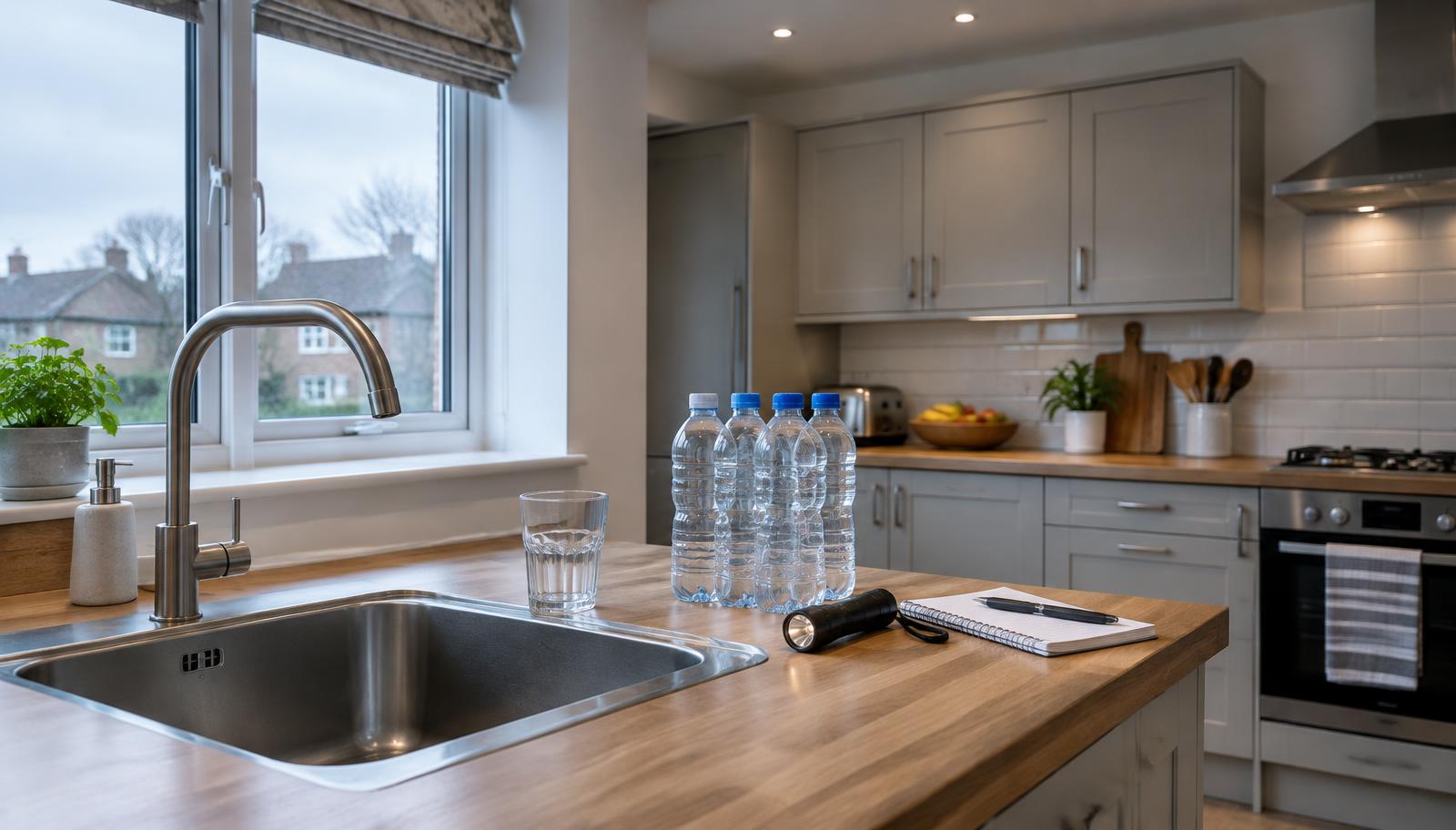
Its suggested preparations include bottled water, food that does not require cooking, a torch, a radio, a power bank and hygiene supplies.
The guidance recommends allowing three litres of drinking water per person per day, with additional water needed for cooking and washing.
Households should also account for their own circumstances, including medication, babies, pets and anyone who may need additional assistance.
The immediate task after a disruption is to review what you actually have left.
Count your available drinking water. Identify the next meal you can prepare under the current instructions. Check whether anyone needs help obtaining an alternative supply or understanding a notice.
Write down any outstanding need and who will address it.
For a broader household inventory, EODSurvival's 72-Hour Household Plan provides a structured way to assess essential supplies and identify gaps.
The purpose is not to create an expensive shopping list. It is to make sure your household can manage the disruption it is actually facing.
Register for Priority Services Before the Next Interruption
Some households may need additional support or communication when essential services are disrupted.
The UK Government recommends that eligible households check the Priority Services Register arrangements offered by relevant utility providers.
These services operate in England, Scotland and Wales, while Northern Ireland has comparable Customer Care Register arrangements.
Eligibility and the assistance available vary by provider, so contact the relevant organisation to register or update your details.
EODSurvival also explains these arrangements in its guide to UK Emergency Alerts and Priority Services.
Keep important support contacts on paper and agree how household members will share official updates if a phone loses power.
Ask neighbours whether they would welcome a check-in rather than assuming what assistance they need.
Once an interruption has ended, take a few minutes to review the household record.
- Which contact number was missing?
- Which message was difficult to interpret?
- Which essential supply ran short?
- Was there an instruction that nobody knew who should follow up?
Those answers provide useful next steps without turning a manageable household plan into an unnecessary shopping exercise.
Before You Put Your Emergency Kit Away
A power cut may be the most visible part of a household disruption, but it is not necessarily the last problem to be resolved.
Before putting away your emergency supplies, check that each affected service has been addressed.
Confirm that electricity has returned to your property, that any applicable drinking-water restrictions have been lifted and that outstanding drainage or wastewater issues have been resolved or are being managed according to the responsible organisation's instructions.
Replace any emergency supplies you have used and update the contact details or notes that proved incomplete.
The lights coming back are welcome news.
Close the electricity entry when the applicable update confirms recovery, then deal with the water and drainage entries on their own evidence.
Put the notebook away when the remaining instructions and household needs have been addressed.
Sources and Further Reading
The following official sources support the guidance in this article.
[1] UK Government — Be Ready for Emergencies
https://beready.campaign.gov.uk/be-ready-for-emergencies/
[2] UK Power Networks — What Is 105?
https://www.ukpowernetworks.co.uk/help/what-is-105
[3] Drinking Water Inspectorate — Receiving a Boil Water Notice
https://www.dwi.gov.uk/receiving-a-boil-water-notice/
[4] GOV.UK — Report a Flood or Possible Cause of Flooding
https://www.gov.uk/report-flood-cause
[5] Ofwat — Supply Interruptions
https://www.ofwat.gov.uk/households/supply-and-standards/supply-interruptions/
This article provides general household preparedness information. Always follow the latest instructions issued by your utility provider, local authority, building management or emergency services for your particular circumstances.